Solution? Don’t be a boring human.
=============
Every few decades, a technology appears that makes people ask a question we’ve asked before:
What will humans do now?
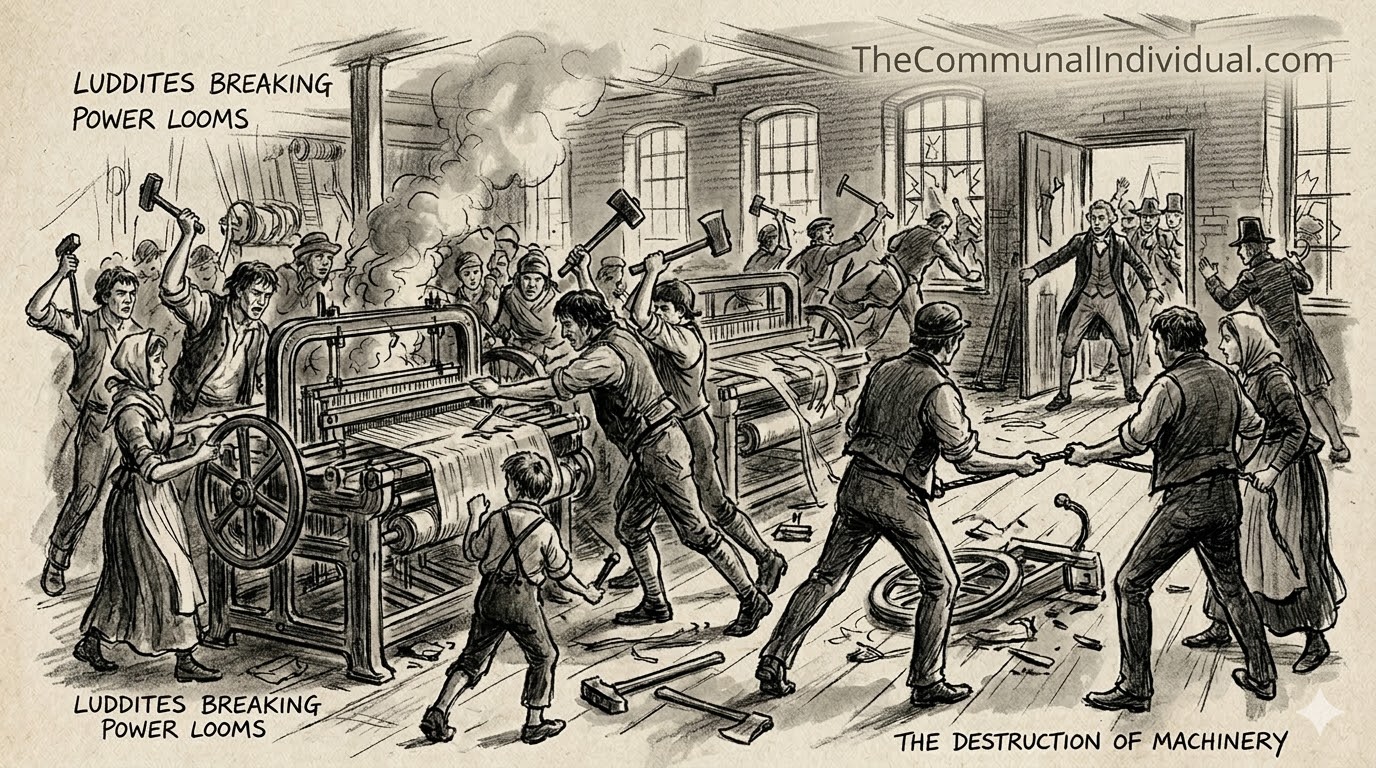
When machines entered factories, people wondered if physical labor would disappear.
Some people even destroyed the machines.
When phones and computers arrived, it was “the dawning of a new age”.
Each time it happened.



When these systems started being used in assembly lines, people wondered if thinking itself would become automated.
But we’ve spent the last several decades using computers as organization, storage, communication, and calculation tools, for our humanness.
Now that artificial intelligence has arrived, the heralding of a new age has returned with force… but with an even greater deal of fear and trepidation.
“AI is going to replace everyone and everything.”
This time, it’s actually much closer to the truth than it ever has been.
As a species, we’ve never invented a technology that can research and invent… itself.
While the foreseeable future presents the reality that AI is unlikely to replace humans in general, what is already well underway is replacing predictable humans.
Fraught with problems? Sure.
But rapidly advancing in ways that we don’t fully comprehend, even for the people working within it, much less those of us just using it, and even less those who are unaware of or turning a blind eye to what’s really happening.
That’s what we now have, as the currently dominant species on this planet – a system that can research and invent itself.
We’re wise to be cautious, but it doesn’t have to fill us with fear or dread.
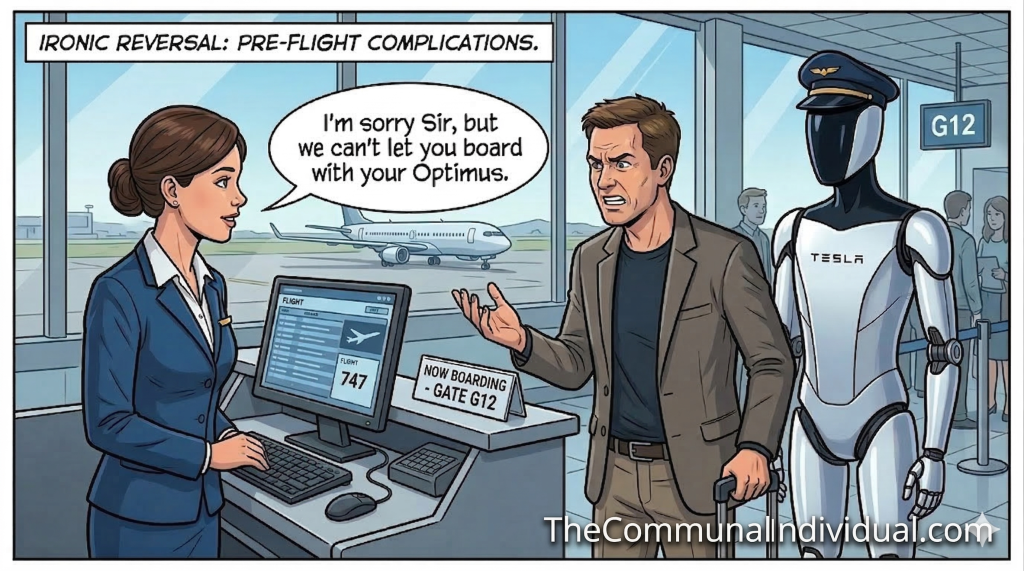
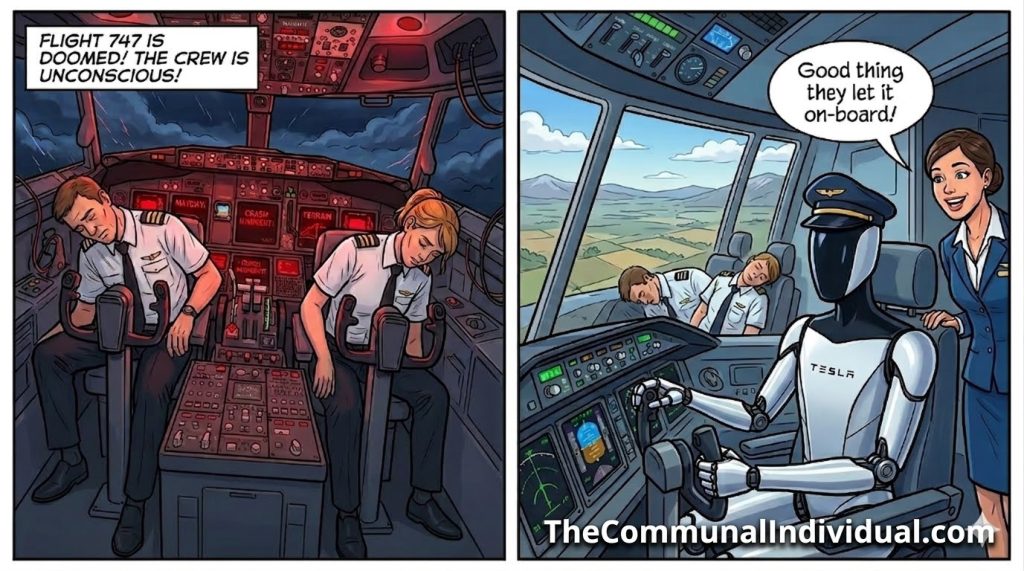
The Real Competition
Artificial intelligence is already exceptionally good at specific work functions:
- Predictable work.
- Structured work.
- Repeatable reasoning.
- Pattern recognition.
- Data synthesis.
It’s already especially good at coding.
And coming soon to every arena, if a task follows a clear set of rules, an AI system can often learn to perform it extremely well.
This is happening exponentially. And this is why AI is already transforming industries like:
- Software development and many types of coding
- Research and data summaries
- Customer support
- Legal drafting
- Website copy
- Standard approaches to marketing
These fields contain large amounts of work that have, up until very recently, required huge amounts of structured human intellectual labor.
But if we get this right, something interesting happens when AI absorbs this predictable work.
While some are hinting at it, not enough people are pushed in the direction of optimism, probably because pessimism sells better.
Here’s what’s good about what’s happening right now…
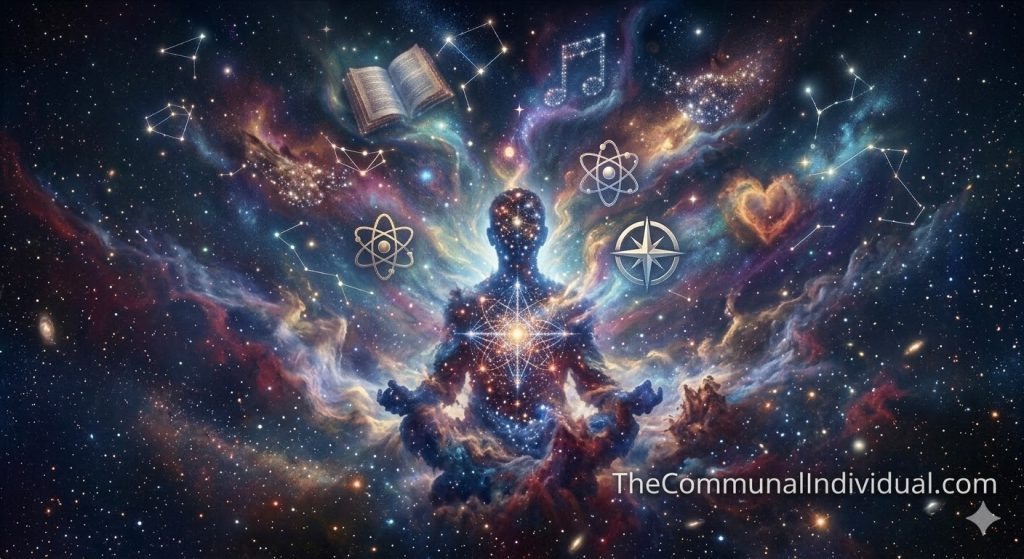
Humans are being pushed in a direction that strongly suggests we spend more time looking at the unique universe inside each and every being on this planet.
When AI absorbs menial work, humans are pushed toward the universe of possibilities, within ourselves.
That is a universe, 8 billion+ universes, that machines simply don’t (yet) have.
The Human Edge
- Machines optimize.
Humans improvise. - Machines follow patterns.
Humans break patterns. - Machines analyze data.
Humans ask strange questions.
Civilization has always advanced, and in fact the various technologies of AI have advanced, because of people who asked weird questions and also did things that initially looked quite irrational.
- A scientist asking a question no one else thought to ask.
- An artist experimenting with an unusual style.
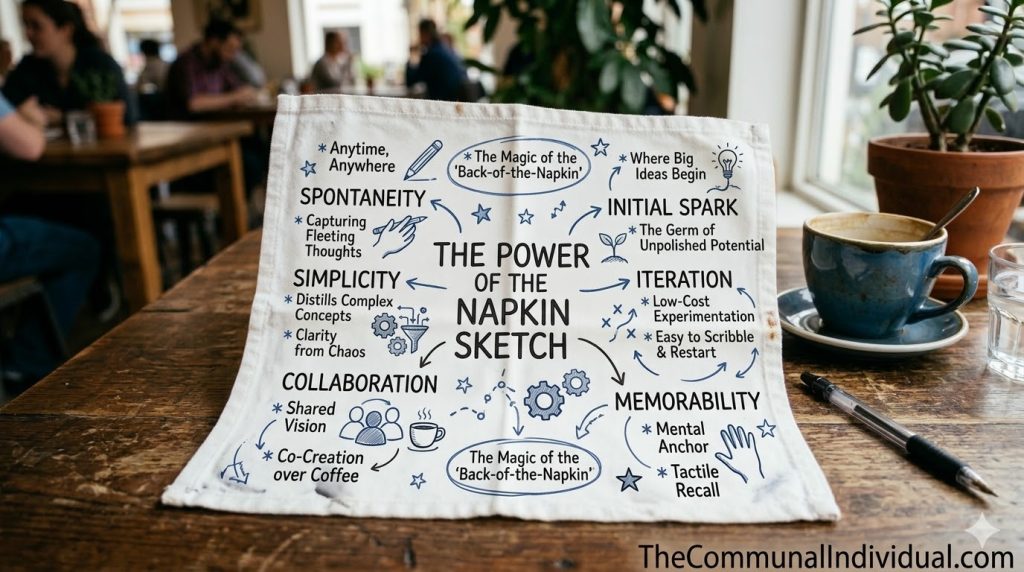
- An entrepreneur sketching a strange business idea on the back of a napkin during a conversation with friends.
Those are all what might be referred to as back-of-the-napkin ideas.
They rarely appear efficient.
But they often are the ideas that change the world.
The Danger of Optimization
There is a subtle risk while we are transitioning into the age of artificial intelligence.
Because advanced societies have generally built a culture (both east and west) that has highly rewarded
- efficiency and optimization
and - entrenched systems of inefficiency
many people have been pushed to suppress the qualities that make them most valuable as individuals.
Small example?
Try calling your health insurance company to dispute a bill.
See how creative or inspired you feel after the interaction.
If you ever experience this kind of call, then this is a great example of both modern efficiency/optimization, and entrenched systems of inefficiency (arguably intentional), working side-by-side.

What gets suppressed in such a system?
- Curiosity
- Humor
- Risk-taking
- Strange ideas
- Deep conversations
This is the messy, “unproductive” (in the sense that it’s hard to measure the productivity associated), human process of exploration that leads to breakthroughs.
Machines have always won, since the introduction of machines in the industrial age, at predictability. Humans can not compete with machines at being predictable. And machines are now winning at the predictable in ways and at speeds we already find hard to comprehend.
And this exponential speed will continue. Algorithms will always calculate faster. Systems will always process more information.
The Opportunity
There are many possible outcomes that don’t involve us being crushed under the super-intelligence of AI Overlords and Overladies. (Let’s be equitable in how we refer to “The AI”, since it really is a thing that is non-gendered.)
With machines absorbing repetitive work, humans have the opportunity to gain something incredibly valuable.
Space.
- Space to explore ideas.
- Space to build communities.
- Space to experiment with creativity.
- Space to ask even bigger questions about what life is actually for.
In this sense, and from this place, the rise of artificial intelligence could (should?) be triggering a shift that we can be optimistic about.
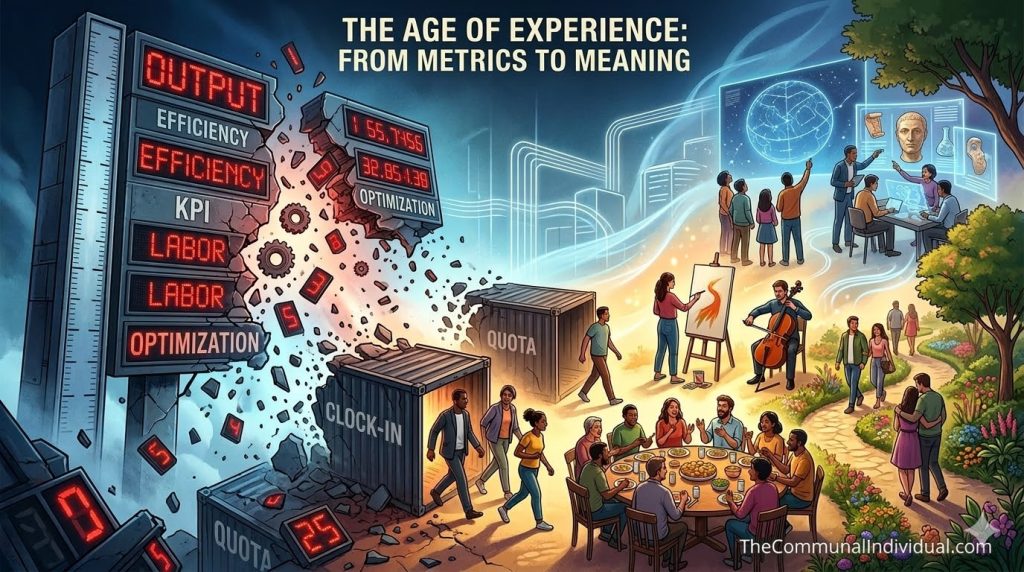
A shift from productivity as the central measure of value… toward human experience.
The Philosophy of Exponential Humanism
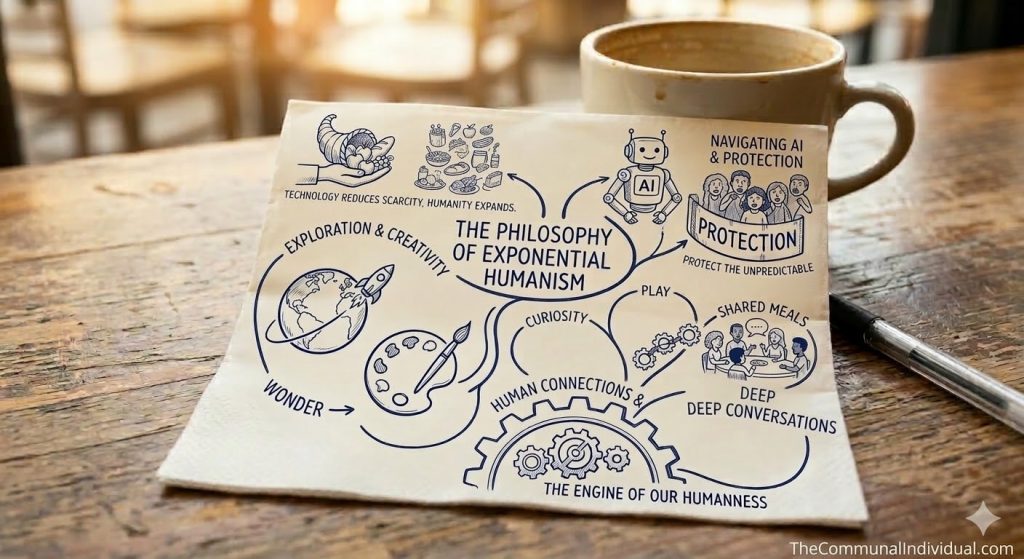
This possibility forms the basis of a philosophy called Exponential Humanism.
It begins with a simple observation:
As technology reduces scarcity, humanity expands.
When survival requires less effort, humans gain the opportunity to explore deeper aspects of life.
- Relationships
- Creativity
- Exploration
- Wonder
But this only happens through the protection and cultivation of those experiences.
Which leads to a simple rule for the age of intelligent machines.
Staunchly protect the unpredictable and unproductive parts of being human.
- Protect curiosity
- Protect play
- Protect shared meals
- Protect long conversations
- Protect back-of-the-napkin ideas
Because these very real human experiences are not inefficiencies.
They are the engines of culture and what it means to be human.
The Communal Individual
The people who thrive in the AI era will likely share a specific trait; they will cultivate both strong individuality and strong community.
They will develop unique skills, ideas, and perspectives as individuals.
But they will also build strong networks of collaboration, both with AI systems and equally as importantly with other humans.
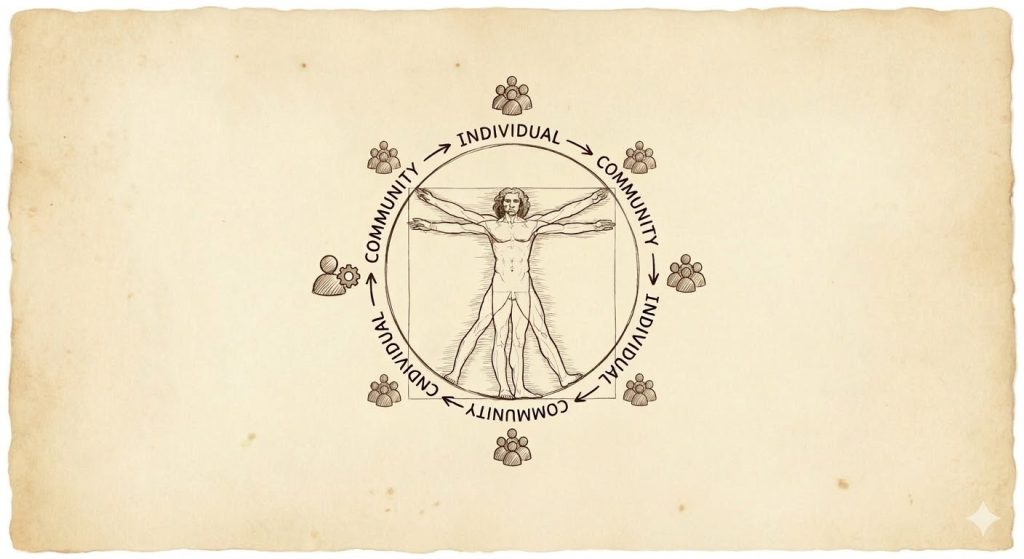
This kind of person can be called The Communal Individual.
Someone who grows personally while strengthening the communities around them.
- A strong individual in the pursuit of growth strengthens communal life.
- Strong communities create environments that strengthen individuals.
Not either/or, not us/them, but rather one feeding and nourishing the other.
The Real Future of Work
The future of work may not need to be pessimistic.
It doesn’t have to be a world where human “work” becomes subjugated under an AI SkyNet or subservient to AI overlords/overladies, or where we all lose purpose and meaning because “The AI” can do everything we used to do so well.
If we get it right, it may instead be a world where the definition of valuable human activity expands.
- People who remain curious will thrive
- People who experiment will thrive
- People who connect ideas across disciplines will thrive
- People who bring creativity and humanity into technology will thrive
In other words:
The people least likely to be replaced by AI are the ones who behave the least like machines.
So the real challenge of the AI era is not competing with algorithms or automations.
The real challenge is remembering what makes humans extraordinary in the first place, when the roles humans have traditionally filled seem to be rapidly filling with algorithms, code, and robotics.
The technology around all of us will continue becoming more powerful.
The future belongs to the humans who advocate for an end to the us/them tribal mentality that has (arguably) gotten us to where we are, but may not be needed, when the history and experience of every tribe’s thoughts (real or imagined) are accessible via an AI chat.
The future will belong to humans who remain deeply, creatively, and unpredictably human.